


Managing Service Requests Across High End Residences
Running a single high end residence well is demanding enough. Running several, often across different countries and time zones, multiplies every one of those demands many times over. Family offices and property managers are increasingly accountable not just for the assets themselves, but for the quality and consistency of the service delivered inside them, even when they are rarely on site.
This accountability is growing for a straightforward reason: there are simply more high end residences to manage, and more technology expected inside them. Deloitte’s Family Office Insights Series counts around 8,030 single family offices worldwide today, up from roughly 6,130 in 2019, with that number projected to pass 10,700 by 2030 (Deloitte, 2024). A separate Ameriprise Financial survey of advisors working with high net worth clients found that around two out of three wealthy Americans now own a second home, with many owning several (Ameriprise Financial, cited in AOL, 2023). More properties, spread across more locations, means more staff, more vendors, and more requests to track.
At the same time, expectations inside these properties are rising. The property technology sector grew by close to seven percent in 2024 and is forecast to expand further through 2025 (ResearchAndMarkets, 2025), and smart home technology now sits among the upgrades most sought by luxury buyers (RE/MAX and the Institute for Luxury Home Marketing, cited in AOL, 2025). Yet the systems most residences still rely on to manage day to day service requests have not kept pace with either trend. This whitepaper looks at where oversight typically breaks down, what genuine visibility requires, and how to evaluate whether a service call system will actually solve the problem.

Why Informal Systems Break Down
Most high end residences still run service requests through a mix of phone calls, text messages, verbal handoffs at shift changes, and the odd note left on a kitchen counter. This works well enough when one household manager oversees one property with a small, stable team. It becomes fragile the moment either variable changes.
Common failure points include:
- No single record of what was requested, by whom, and when
- Requests handled by whichever staff member happens to answer, with no clear ownership once the call ends
- No way to confirm a request was actually completed, only assumed
- Knowledge lost when a staff member leaves or is on leave, with nothing written down to hand over
- Property managers or family office staff finding out about a problem only when the principal raises it directly
None of this reflects poorly on household staff. It reflects the limits of informal systems under real operational pressure, especially across multiple properties where the family office is not on site to catch what falls through.
What Oversight Actually Requires
For a property manager or family office to genuinely know what is happening across a portfolio of residences, without resorting to constant phone calls or site visits, four things need to be true:
1. Visibility. Every request is logged somewhere central, not held in someone’s head or scattered across a messaging thread.
2. Ownership. Each request is assigned to a specific person, so nothing sits unresolved.
3. Confirmation. Completion is recorded with a timestamp, not assumed.
4. History. A searchable record exists for every property, useful for spotting recurring issues, briefing new staff, or answering a principal’s question with confidence rather than a guess.
This is not about replacing household staff or adding administrative burden. Done well, it removes the burden of remembering everything, and gives property managers the confidence to step back without losing sight of what matters.

A Framework for Evaluating Service Call Systems
Whether the system under consideration is GEST or any other option, five questions are worth asking before committing to it:
- Is it intuitive enough that staff will actually use it? A system that feels foreign to how a household already communicates will be abandoned within weeks, however well it is specified.
- Can it be installed without disrupting the household? Some systems require extensive integrator work across every room. Others can be self installed with a manual and be live within a day.
- Does it give the property manager or family office a live view, not just staff? Oversight only works if the person accountable can actually see the data, not hear a summary secondhand.
- Does it hold a full history per property? A system with no memory beyond the current week does not help identify patterns or demonstrate consistency to a principal.
- Is support available when something goes wrong, not just during setup? Systems are judged by how reliable they are on an ordinary Tuesday, not during a sales demonstration.

How This Looks in Practice
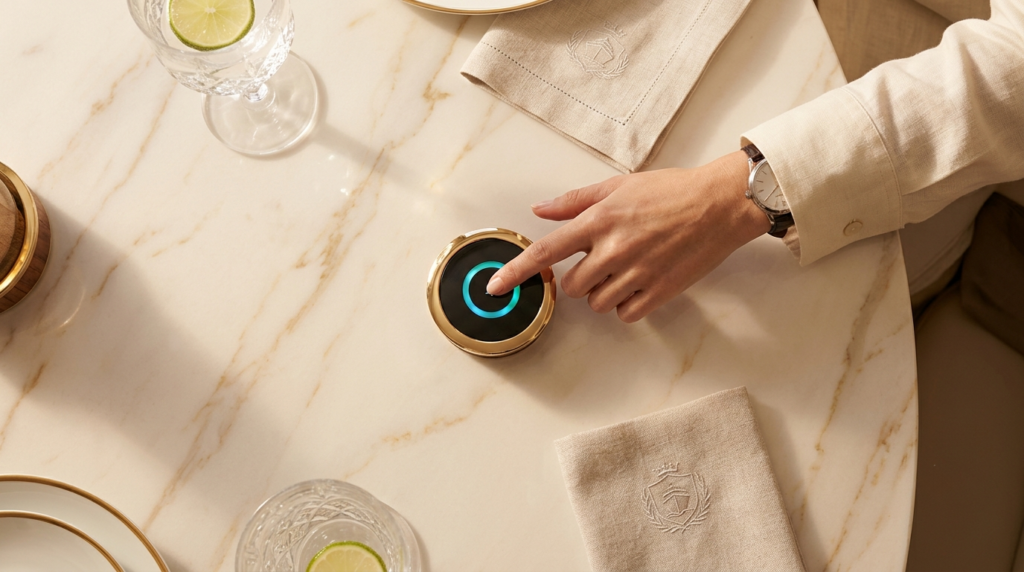
GEST is YachtCloud’s service call system, built originally for superyacht crews and now used across high end residences through YachtCloud’s Residential division. It gives every request a clear owner, a status, and a timestamp, and gives property managers and family office staff a live overview across every property they oversee, without needing to call the house to ask.
Because GEST is available as a direct purchase with a self install manual, a property can be live without waiting on an integrator’s schedule. Installation by a certified integrator remains available where preferred, but it is not a requirement, which matters for family offices managing several properties on different timelines.
The result is not a system that inserts itself between staff and the household they serve. It sits quietly behind the scenes, so the household can keep delivering the seamless, discreet service today’s principals expect, while the people accountable for it finally have a clear record to point to.
Frequently Asked Questions
A service call system is software that logs, assigns and tracks requests made to household staff, replacing informal phone calls and messages with a single record showing what was asked, who owns it, and whether it has been completed.
Property managers typically need a centralised platform that logs requests from every property in one place, assigns ownership per request, and gives a live overview without requiring a phone call to each residence.
Not necessarily software built exclusively for household staff management, but a system that gives visibility, ownership and a historical record materially reduces the risk of dropped requests, particularly across more than one property.
Some can. GEST, for example, is designed for self install with a manual, meaning a residence can be live without waiting for an integrator’s schedule, although integrator installation remains available where preferred.
General facilities management platforms are typically built for commercial buildings and staff hierarchies. GEST was purpose built for the standards, discretion and pace expected in high end residential and superyacht environments.

See it for yourself
If this reflects a gap you recognise across the properties you oversee, GEST is worth a closer look. Visit yachtcloud.com/gest to see how it works, or contact the YachtCloud team directly at [email protected].
Know a colleague who would find this useful?
If you manage service across more than one high end residence, chances are someone in your network does too. Feel free to pass this whitepaper along. Referrals from people who understand this problem firsthand are the ones we value most.